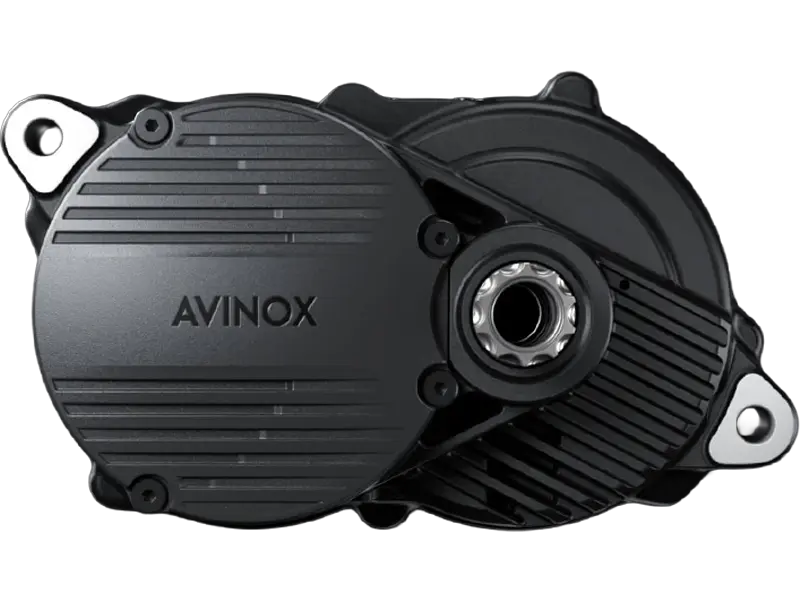
Avinox M1
DJI's market entry in 2024 was a real bang. Even though the name of the drone manufacturer has meanwhile disappeared from the Avinox branding, the shockwaves are still reverberating. 105 Nm (120 Nm in Boost), up to 1000 watts of power, and all that at just over 2.5 kg in weight—impressive. Furthermore, they also did their homework on the topic of response behavior and app connectivity. In conjunction with the high-resolution touch display and two batteries with high energy density, Avinox offers a really strong overall package with the M1.
Battery System & Chargers
🔋 Battery System
| Model | Capacity | Weight | Energy Density | Dimensions | Mounting |
|---|---|---|---|---|---|
| Avinox FS800 | 800 Wh | 3.74 kg | 214 Wh/kg | 561 x 71 x 49 | Internal |
| Avinox FS600 | 600 Wh | 2.87 kg | 209 Wh/kg | n/a | Internal |
🔌 Chargers
| Model | Current | Dimensions |
|---|---|---|
| Standard Charger | 4 A | n/a |
| Fast Charger | 12 A | n/a |
Power Characteristics
Shows how much power the motor delivers for a given rider input. The value shown is pure motor power, adjusted for input and drivetrain losses.
Input vs. Output: Avinox M1
In its highest assist mode, the Avinox motor boasts an impressive power delivery. At just 50 watts of rider input, we are already measuring over 400 watts of motor output, and at around 70 watts, the M1 is already leaving the bulk of its competitors in the dust. It’s impressive, but one thing is clear: anyone riding in this power range will likely struggle to keep the motor in check.
Power vs. Torque: Avinox M1
🧮Power (solid, left axis) and the derived torque (dotted, right axis) across the cadence range. Torque peaks at low cadence and drops as rpm rises — even when power output stays constant.
Unterstützungsstufen
Comparison of different assistance modes (e.g. Eco, Trail, Turbo).
Profile: Avinox M1
Cadence Behavior
Shows the optimal RPM range.
Power vs. Cadence (Relative (%))
Our cadence analysis of the Avinox at 130 watts of rider input yields some interesting results. It shows that the motor definitely needs some revs to truly unleash its power. It’s only from a cadence of around 80 rpm upwards that it can clearly pull away from the competition. After peaking at roughly 100 rpm, the power output drops off slightly again.
Thermal Performance
Shows power output performance over 15/20 minutes under constant full load.
20 min
The Avinox's handling of derating is special: Even after 20 minutes, the motor continues to reach its maximum output despite its brute power. But: We can observe a strong pulsing of power, right from the start. Occasionally, we see a power fluctuation of 10% and more here. Accordingly, this is unlikely to be for thermal reasons but rather a matter of the control system: Possibly the drive manages to hold out so long this way—despite high power. Also noteworthy: The housing of the motor got significantly hotter than 100°C in our test.