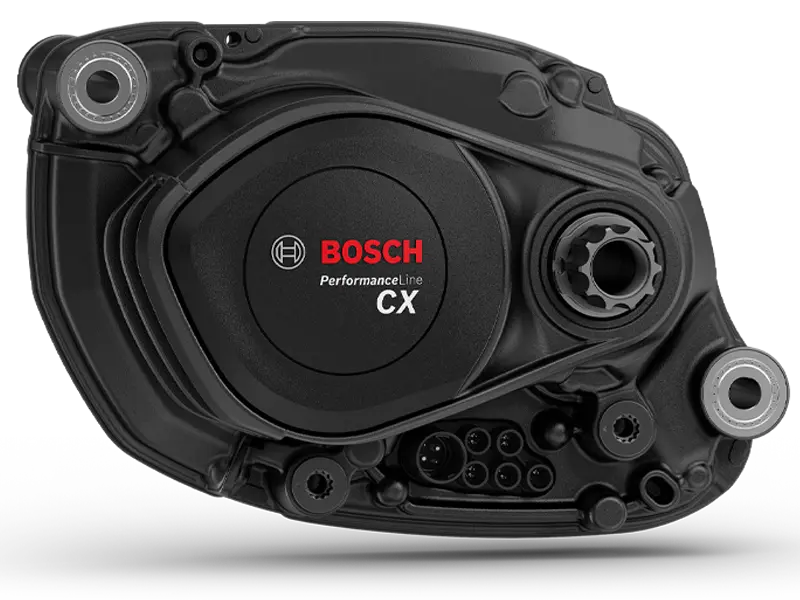
Bosch CX 5 (100 Nm)
The evolution of the bestseller introduced in 2024. Bosch initially refrained from an arms race regarding Nm figures (still 85 Nm/600 W) but optimized everything else: The Gen 5 is quieter, approx. 100 grams lighter, and eliminates the predecessor's infamous rattling thanks to a decoupled gearbox. The sensor technology has been refined, making the response behavior even more sensitive. In addition, the new 2-point mounting allows manufacturers more flexible frame designs. In the summer of 2025, the motor received a free performance upgrade to up to 100 Nm and 750 watts of power.
Battery System & Chargers
🔋 Battery System
| Model | Capacity | Weight | Energy Density | Dimensions | Mounting |
|---|---|---|---|---|---|
| Powertube 800 | 800 Wh | 3.9 kg | 205 Wh/kg | 424 x 77 x 71 | Internal |
| Powertube 750 | 750 Wh | 4.3 kg | 174 Wh/kg | 484 x 84 x 65 | Internal |
| Powertube 625 | 625 Wh | 3.6 kg | 174 Wh/kg | 415 x 84 x 65 | Internal |
| Powertube 600 | 600 Wh | 3 kg | 200 Wh/kg | 424 x 71 x 67 | Internal |
| Powertube 540 | 540 Wh | 3 kg | 180 Wh/kg | 424 x 71 x 67 | Internal |
| Powertube 500 | 500 Wh | 3 kg | 167 Wh/kg | 345 x 84 x 65 | Internal |
| Compactube 400 | 400 Wh | 2 kg | 200 Wh/kg | 352 x 57 x 75 | Internal |
| Powerpack 800 Frame | 800 Wh | 3.9 kg | 205 Wh/kg | 345 x 95 x 100 | Frame |
| Powerpack 545 Frame | 545 Wh | 3 kg | 182 Wh/kg | 338 x 93 x 81 | Frame |
| Powerpack 400 Frame | 400 Wh | 2.2 kg | 182 Wh/kg | 336 x 91 x 62 | Frame |
| Powerpack 500 Rack | 500 Wh | 2.8 kg | 179 Wh/kg | 376 x 122 x 64 | Rack |
| Powerpack 400 Rack | 400 Wh | 2.7 kg | 148 Wh/kg | 376 x 122 x 64 | Rack |
➕ Range Extender Available
| Model | Capacity | Weight | Dimensions |
|---|---|---|---|
| Powermore 250 | 250 Wh | 1.5 kg | 200 x 88 x 75 |
🔌 Chargers
| Model | Current | Dimensions |
|---|---|---|
| Standard Charger | 4 A | 190 x 90 x 50 |
| Compact Charger | 2 A | 167 x 76 x 45 |
Power Characteristics
Shows how much power the motor delivers for a given rider input. The value shown is pure motor power, adjusted for input and drivetrain losses.
Input vs. Output: Bosch CX 5 (100 Nm)
Bosch remains true to itself with the newest generation CX: If you want to call up maximum power, you have to pedal hard. Specifically, this means you only get close to the 680 watts we measured as peak output with around 200 watts of rider input. Nevertheless: After the performance upgrade and with the correspondingly adjusted support levels, the Bosch CX is one of the most powerful motors on the market.
Power vs. Torque: Bosch CX 5 (100 Nm)
🧮Power (solid, left axis) and the derived torque (dotted, right axis) across the cadence range. Torque peaks at low cadence and drops as rpm rises — even when power output stays constant.
Unterstützungsstufen
Comparison of different assistance modes (e.g. Eco, Trail, Turbo).
Profile: Bosch CX 5 (100 Nm)
No other drive manufacturer offers as many different support levels as Bosch does. Two fundamental differences stand out: While Turbo, Sport, Tour, and Eco increase linearly in their power, eMTB+, eMTB, and Tour+ possess a progressive power curve. The Tour+ mode is particularly interesting and covers the widest power spectrum.
Cadence Behavior
Shows the optimal RPM range.
Power vs. Cadence (Relative (%))
Bosch remains Bosch: Just like its predecessor, the Bosch CX Gen 5 is remarkably unimpressed by different cadences. After reaching its performance plateau at approx. 50 rpm, it can hold this constant and without any fluctuations well beyond 100 rpm. This makes the motor not only very versatile but also extremely predictable.
Thermal Performance
Shows power output performance over 15/20 minutes under constant full load.
20 min
The motor's high performance takes its toll on thermal behavior: After just around eight minutes, the housing reaches a temperature of 80°C and the drive begins to reduce its power. After about 12 minutes, it settles at slightly above 80% of its original output. However, due to the very slow and gentle drop in power, this is probably hardly noticeable in practice.